Rovix Motion
China Best High Efficiency Gear Motor Manufacturer?
Selecting a High Efficiency Gear Motor is not simply a price comparison. It is a decision about torque, speed, heat, noise, service life, and energy use. In a real factory, the motor may run beside a conveyor for eighteen hours daily. Dust may enter the housing. Frequent starts may increase thermal stress. These details expose weak engineering quickly.
John Malinowski, a recognized motor application specialist and author of energy-efficiency guidance, offers a practical principle: “The most efficient motor is the one properly sized for the application.” This point matters when comparing Chinese manufacturers. A smaller unit may cost less, yet overloading can raise temperature and shorten bearing life. An oversized unit may waste energy and reduce operating efficiency.
Reliable manufacturers should show more than attractive catalog figures. Buyers should examine measured gearbox efficiency, motor efficiency class, rated torque, reduction ratio, insulation grade, IP protection, noise levels, and test procedures. ISO 9001 certification can support process consistency, but it does not replace product testing. Factory audits, sample testing, and traceable inspection records remain valuable.
The best supplier may not be the cheapest one. It should explain its calculations clearly. It should also admit limitations. No factory is perfect. Some published performance data may reflect controlled laboratory conditions, not dusty production floors. That difference deserves attention.
This guide evaluates China-based manufacturers through engineering capability, customization experience, quality control, delivery reliability, and after-sales support. The goal is practical selection, not exaggerated promotion. A truly High Efficiency Gear Motor should save energy while remaining stable under the exact load it serves.
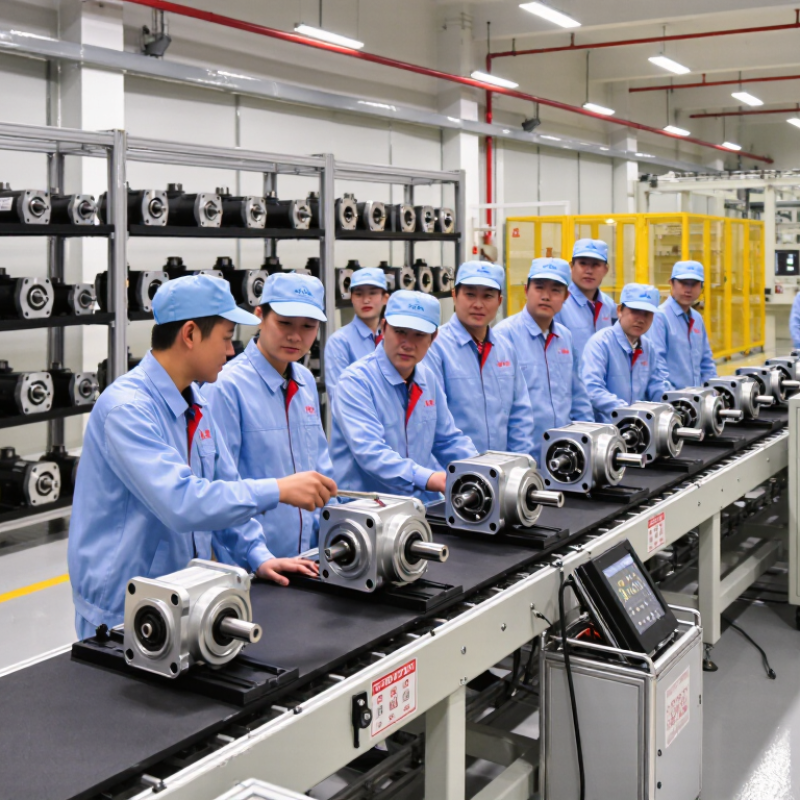
China Best High Efficiency Gear Motor Manufacturer?
A gear motor combines an electric motor with a gearbox to deliver controlled speed and useful torque. The gearbox reduces rotational speed and increases output torque. A simple estimate is output torque = motor torque × gear ratio × efficiency. For example, a 10:1 ratio can raise torque significantly, but friction reduces the final result.
Efficiency above 90% is possible, but it depends on the operating point. A compact helical gearbox may reach this level near its rated load and speed. Measurement should include motor, gears, bearings, seals, and coupling losses. A reliable manufacturer should provide test data, temperature readings, noise values, and tolerance details. Ask whether efficiency was measured continuously or only at peak performance. The difference matters.
Torque selection needs practical judgment. A conveyor starting with a heavy box requires more torque than one running steadily. Engineers should check starting torque, service factor, duty cycle, and overload conditions. A larger motor is not always safer; it may waste energy and create excess heat. The calculation looks clean. The workshop rarely is.
Gear ratio also affects response time. High ratios provide stronger output force but slower movement and greater backlash risk. Low ratios improve speed but may reduce control under sudden loads. During inspection, measure shaft play, vibration, and surface temperature after several hours. These details reveal manufacturing quality better than polished claims. Even a well-designed unit can perform poorly when lubrication, alignment, or voltage is neglected.
China Best High Efficiency Gear Motor Manufacturer?
Choosing a high-efficiency gear motor requires more than reading an IE label. GB 18613-2020 sets energy-efficiency requirements for eligible three-phase asynchronous motors used in China. It defines minimum efficiency values, efficiency grades, and testing conditions. IEC 60034-30-1 classifies motor efficiency through IE classes, including IE1, IE2, IE3, and IE4. These standards help engineers compare motor performance under controlled conditions.
The details matter. A motor marked IE3 may perform differently when voltage, frequency, load, or cooling conditions change. Gear losses also affect the complete drive system, although the IEC motor class mainly describes the motor itself. In practical factory testing, I would request efficiency data at 50%, 75%, and 100% load. Check the rated speed, duty cycle, insulation class, and gearbox service factor. Small data gaps can become large energy costs.
Tips: Ask for the test standard and report version. Confirm whether values follow GB 18613-2020 or IEC 60034-30-1. Compare identical power ratings and operating points. Do not assume higher efficiency always means lower total cost; purchase price, maintenance, lubrication, and operating hours also matter. Some published figures look precise, but real installations are rarely perfect. Field measurements may reveal unexpected heat, vibration, or partial-load losses.
The best high-efficiency gear motor depends on operating conditions, not only the IE rating. IEC 60034-30-1 classifies motor efficiency from IE1 to IE5. However, its values vary with output, speed, and pole design. A 7.5 kW motor may show IE3 efficiency near 92%, while IE4 approaches 94%. IE5 can exceed 95% in suitable designs. These figures are illustrative, not universal.
Rated load changes the decision. At full load, IE4 or IE5 can reduce losses during continuous operation. At 50% load, efficiency curves may narrow the difference. Not always better. A gearbox also introduces mechanical losses, so the complete drive system deserves testing. The U.S. Department of Energy reports that motor-driven equipment uses a major share of industrial electricity. The International Energy Agency also identifies efficient motors and variable-speed control as important industrial saving measures.
For 10,000 operating hours, a 7.5 kW output motor consumes about 75,000 kWh before accounting for losses. At 92% efficiency, input demand is approximately 8.15 kW. At 95%, it falls near 7.89 kW, saving roughly 2,600 kWh. Actual savings depend on duty cycle, loading, starts, ambient temperature, and maintenance. Intermittent S3 duty may favor a different design than continuous S1 duty. Ask for measured efficiency curves, thermal limits, gearbox service factors, and test evidence under your real load. That step is often missed.
China Best High Efficiency Gear Motor Manufacturer?
Verifying a gear motor manufacturer requires more than checking efficiency figures on a website. During supplier audits, engineers should inspect the ISO 9001 certificate, scope, expiry date, and issuing body. The certificate should cover design, production, and quality control activities. A certificate alone proves little.
Ask for IEC test reports linked to a specific motor model and rated condition. Check efficiency, temperature rise, noise, vibration, and load results. Report numbers, test dates, laboratory details, and equipment calibration records should match the supplied product. Small mismatches deserve questions.
IP ratings also need careful verification. An IP65 claim should identify the tested enclosure and test method. Inspect cable glands, shaft seals, terminal boxes, and housing joints. In practice, sealing may weaken after assembly or repeated maintenance. That detail is easy to miss.
A factory visit can reveal more than polished documents. Watch winding inspection, gearbox backlash checks, grease filling, and final no-load testing. Request sample records from recent batches, not selected perfect examples. Some manufacturers may provide incomplete evidence, while buyers may also ask vague questions. That shared weakness can distort the assessment.
Independent laboratory reports add useful confidence, especially for unfamiliar suppliers. Still, one report cannot represent every production batch. Compare test data with your voltage, duty cycle, ambient temperature, and mounting position. High efficiency under laboratory conditions may fall in dusty plants or frequent-start applications. Reliability lives in those practical details.
| Verification Dimension | Relevant Standard or Evidence | Objective Data to Request | Practical Acceptance Check | Why It Matters for Gear Motors |
|---|---|---|---|---|
| Quality Management System | ISO 9001:2015 certification | Certificate number, certification scope, issuing certification body, initial certification date, expiry date, and latest surveillance status | Confirm that the certificate is valid and that the scope covers design, manufacture, assembly, or testing of motors and geared motors as applicable | Shows that documented processes exist for purchasing, production control, inspection, corrective action, and continual improvement; it does not by itself prove motor efficiency |
| Ingress Protection | IEC 60529 IP Code | Declared IP rating, test configuration, enclosure type, mounting orientation, and laboratory test report | Verify that the tested configuration matches the quoted product, terminal box, shaft seal, connectors, and cooling arrangement | Provides defined protection levels against solid foreign objects and water; the required rating depends on the installation environment |
| Typical IP Interpretation | IEC 60529 rating structure | First digit for solid-particle protection and second digit for water protection | For example, IP55 indicates protection against dust deposits that could interfere with operation and protection against water jets from any direction | Helps match enclosure protection to indoor, dusty, humid, outdoor, or washdown applications without assuming that a higher rating is always necessary |
| Motor Performance Testing | IEC 60034-1 and applicable IEC 60034 test methods | Rated voltage, frequency, output power, speed, current, torque, efficiency, power factor, temperature rise, and test conditions | Check that the report identifies the tested motor type, rated operating point, instruments, uncertainty where stated, and test date | Confirms that published electrical and mechanical performance is supported by repeatable test data rather than catalogue estimates alone |
| Energy Efficiency Classification | IEC 60034-30-1 | Declared efficiency class, such as IE2, IE3, or IE4, together with rated power, poles, frequency, and efficiency values | Compare the tested efficiency with the applicable IEC efficiency limits for the same motor rating and operating conditions | Provides a standardized method for comparing motor efficiency classes; gearbox efficiency must be evaluated separately from motor efficiency |
| Loss and Efficiency Measurement | IEC 60034-2-1 | Input power, output torque, speed, stator losses, rotor losses, mechanical losses, and declared measurement method | Ensure the report states the test method and separates motor efficiency from the efficiency of the complete gear-motor assembly | Prevents misleading comparisons in which a high-efficiency motor is presented as the efficiency of the entire geared drive |
| Gearbox Mechanical Performance | Manufacturer-specific gearbox test procedure supported by documented internal controls | Rated output torque, service factor, gear ratio, output speed, backlash where relevant, noise, vibration, and thermal performance | Request test records for the exact gear geometry, ratio, lubrication, mounting position, and duty cycle being quoted | Motor efficiency alone cannot confirm load capacity, durability, thermal limits, or transmission losses |
| Thermal Capability | IEC 60034-1 temperature-rise and operating-condition requirements | Insulation class, temperature-rise result, ambient temperature assumption, duty type, overload condition, and cooling method | Confirm that the test conditions match the actual duty cycle, ambient temperature, installation altitude, and available ventilation | Excessive temperature is a major contributor to insulation aging, lubricant degradation, and reduced service life |
| Routine Production Testing | Factory inspection and end-of-line test records | Winding resistance, insulation resistance, no-load current, rotation direction, vibration, noise, leakage, and functional test results | Ask for a blank inspection record and a completed sample linked to a traceable production batch or serial number | Demonstrates that each production unit is checked, not only that a prototype or type sample passed testing |
| Calibration and Traceability | Calibration certificates and measurement traceability records | Calibration dates, equipment identification, measurement range, reference standards, and next calibration due date | Check that torque, speed, electrical, temperature, and vibration instruments are within calibration during testing | Improves confidence that reported efficiency, torque, temperature, and vibration values are technically credible |
| Document Consistency | Technical datasheet, nameplate, drawing, quotation, and test report | Matching model code, rated power, voltage, frequency, ratio, shaft dimensions, mounting form, IP rating, and efficiency class | Reject or clarify documents containing inconsistent ratings, different enclosure designs, or different tested configurations | Ensures that certification and test evidence applies to the actual product configuration being purchased |
| Supplier Evaluation Result | Evidence-based qualification review | Valid documents, matching product scope, complete test data, traceable calibration, and satisfactory sample inspection | Use a pass, conditional approval, or fail status for every verification dimension instead of relying on a single certificate | A balanced decision considers quality management, efficiency, protection, mechanical capability, testing discipline, and application fit |
Selecting China’s best high-efficiency gear motor manufacturer requires more than comparing purchase prices. In real factory projects, energy use, maintenance access, downtime, and replacement speed shape the true lifecycle cost. A motor that costs less initially may consume more power or require frequent gearbox servicing. Request tested efficiency data, rated load curves, noise readings, and documented quality procedures. Ask how performance is verified before shipment.
Warranty terms also deserve careful review. Check coverage length, exclusions, response times, and spare-parts availability. A two-year warranty has limited value if fault analysis takes eight weeks. Reliable suppliers provide clear inspection records, installation guidance, and technical support from engineers with practical field experience. Still, documents can look better than reality. Speak with recent industrial users when possible.
Tips: Build a three-to-five-year ROI model using operating hours, electricity rates, lubrication, repairs, and expected downtime. Compare identical duty cycles, not attractive catalog figures. Include shipping, commissioning, and disposal costs. For example, a 2% efficiency gain can matter greatly in continuous operation, but not every application will recover the premium quickly. Test a sample under your actual load before approving a large order. That step costs time. It may prevent an expensive mistake.
Illustrative comparison of anonymous supplier options. Lower total cost may matter more than the purchase price alone.
What the chart shows: Estimated purchase, electricity, and maintenance costs over five years. Under these assumptions, the 93%-efficiency option has the lowest estimated lifecycle cost at about $44,690, compared with $46,636 for the standard option.
3-year energy-only ROI: The 93%-efficiency option costs $1,000 more upfront than the standard option and is estimated to save about $1,408 in electricity over three years—an estimated 41% ROI on the price premium, with simple payback in about 2.1 years. Maintenance savings are excluded from this ROI calculation.
Assumptions: 4 kW output, 4,000 operating hours per year, electricity at $0.12/kWh, and a five-year evaluation period. Efficiency-based electricity costs are calculated as output power ÷ efficiency × operating hours × electricity rate. Warranty periods and maintenance reserves are illustrative planning assumptions, not supplier quotes or guarantees. Actual costs depend on the operating duty, local tariff, installation, warranty terms, and maintenance requirements.
The gearbox reduces speed and increases output torque, while friction takes away some power. A 10:1 ratio can raise torque considerably. Not perfectly.
Consider starting load, duty cycle, overloads, and service factor. A conveyor starting with a heavy box needs more torque than one running steadily. The calculation looks tidy; the workshop may not.
Yes, near a suitable rated load and speed. Measure the complete drive, including the motor, gearbox, bearings, seals, and coupling. Peak figures alone can mislead.
Not necessarily. At partial load, efficiency differences may narrow, and gearbox losses still matter. Compare measured curves under your actual operating conditions.
At 92% efficiency, input demand is about 8.15 kW; at 95%, it is about 7.89 kW. That difference could save roughly 2,600 kWh. Actual use varies.
A higher ratio usually provides more output force but slower movement. It may also increase backlash risk. Check shaft play.
Match reports to the exact motor model and rated conditions. Review test dates, laboratory details, calibration records, temperature rise, noise, and vibration. Ask about mismatches.
Confirm which enclosure was tested and how. Check cable glands, shaft seals, terminal boxes, and housing joints. Maintenance can weaken sealing.
After several hours, measure surface temperature, vibration, and shaft play. Also check lubrication, alignment, and voltage. Small details count.
Selecting the best High Efficiency Gear Motor starts with understanding how torque, gear ratios, operating speed, and mechanical efficiency affect real-world performance. A motor exceeding 90% efficiency can reduce energy loss, but the correct choice also depends on rated load, starting conditions, duty cycle, and expected operating hours. IE3, IE4, and IE5 motors should therefore be compared under realistic conditions, including continuous or intermittent use and a projected 10,000-hour service period.
A reliable evaluation should include compliance with GB 18613-2020 and IEC 60034-30-1 efficiency classifications, along with independent IEC test reports and ISO 9001 quality management certification. Buyers should also verify suitable IP protection, temperature limits, materials, maintenance requirements, and available technical support. Instead of focusing only on the purchase price, compare total lifecycle cost, energy consumption, downtime risk, warranty coverage, and spare-part availability. A supplier offering measurable performance data and a clear three- to five-year return-on-investment calculation is more likely to provide lasting value.
